Why the Moon’s Beginning Inspires Me: A Student’s Reflection on the Giant Impact Hypothesis

I have always found space interesting, and learning about how the Moon may have formed really caught my attention. When I heard about the collision theory in school, I was curious about how an impact could create something as important as the Moon. This is why I chose to learn more about the Giant Impact Hypothesis.
The Giant Impact Hypothesis is currently the most accepted theory in science for the formation of our Moon, which occurred about 4.5 billion years ago, during the early stages of the solar system. At this time, the planets were still developing, and there were many collisions between large bodies.

How the Collision Happened
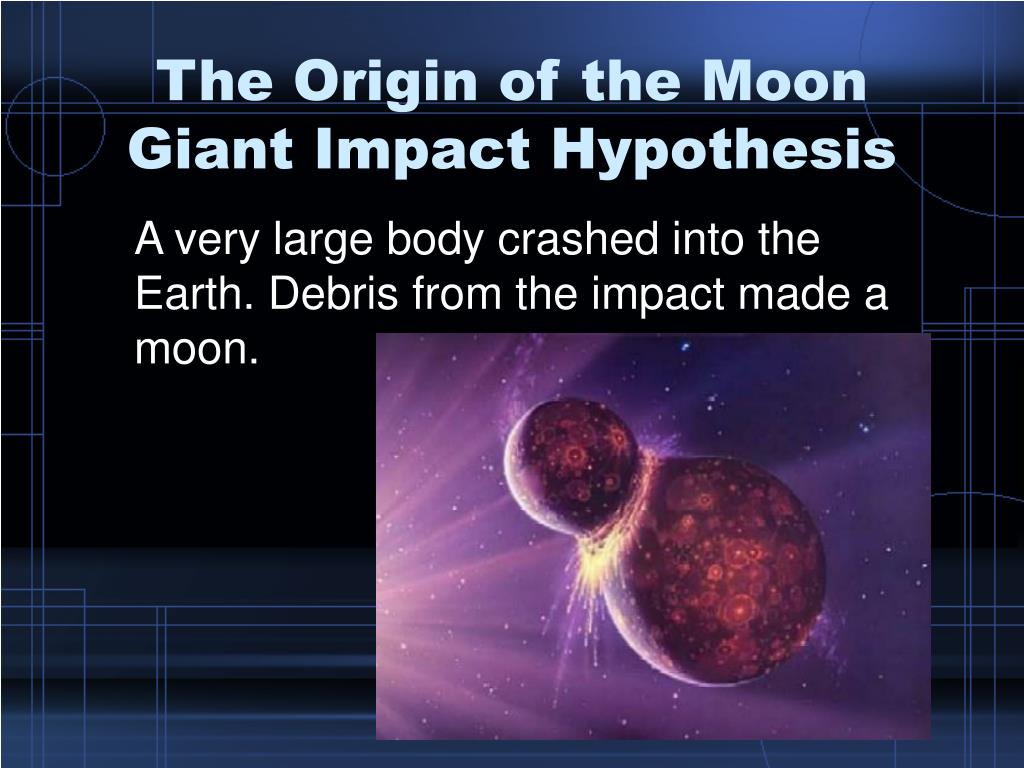
This theory holds that Earth was struck by a giant proto-planet about the size of Mars, which scientists named Theia after the Greek titan goddess of the sky. The impact was so powerful that it melted significant portions of Earth’s crust and mantle, sending large amounts of debris into space.
Lunar rock samples suggest that the Moon’s surface melted from the intense heat generated by this explosion before cooling and solidifying. Over millions of years, Earth’s gravity pulled this debris into a dense, rotating ring around the planet. As the ring cooled, particles stuck together, forming larger chunks that eventually became the Moon. The proto-planet Theia was completely destroyed in the collision, with its remnants merging with Earth.

Evidence From the Moon
One major reason scientists trust the Giant Impact Hypothesis is the evidence from the Apollo missions in the late 1960s and early 1970s. During these missions, astronauts travelled to the Moon and brought back over 300 kilograms of lunar rocks and soil for scientists to study. When researchers studied these samples, they found that the Moon was composed of chemical compounds, similar to those of Earth’s outer layer, or mantle, especially its isotopic composition. The oxygen isotopes in Moon rocks and Earth rocks match almost perfectly, which is unusual. The similarities between the Moon and Earth suggest they were once part of the same body. These similarities do not fit any other Moon formation theory.
)
Why Scientists Believe This Theory
Another clue comes from the Moon’s internal structure. The Moon has a small iron core compared to other planets and to Earth, which has a much larger core in proportion to its size. This supports the impact theory, indicating that the Moon formed from lighter, rocky material scraped off Earth’s outer layers during the massive collision, while most of the heavier iron and dense metals remained deep within Earth.
Moon rocks are also dry and lack certain materials that evaporate easily at high temperatures. This makes the idea that the Moon formed in a very hot environment, such as a huge explosion, which would have caused volatile materials to escape into space.
The Moon formed very close to Earth from debris left by the giant impact. In those early days, when the Moon orbited much closer to our planet, Earth’s gravity exerted strong tidal forces. The forces slowed the Moon’s rotation to match the time it takes to orbit Earth, which is known as tidal locking. This is why we always see the same face of the Moon from Earth.

How the Moon affects the Earth
The massive collision between Earth and Theia did more than just create the Moon. It also had major and lasting effects on our planet. Scientists believe the impact knocked Earth off its original upright axis, tilting our planet to its current angle of about 23.5 degrees. This tilt is essential because it leads to Earth’s regular seasons like spring, summer, fall, and winter as different parts of the planet receive varying amounts of sunlight throughout the year. The Moon helps keep this tilt stable. Its gravitational pull helps keep the Earth stable, preventing its axis from wobbling too much over time. Without the Moon, Earth’s tilt could change constantly, leading to extreme climate shifts that might have made life impossible.

What Modern Research Shows
Today, scientists use supercomputers to create simulations that replicate this collision and help understand what happened. Although the giant impact occurred billions of years ago, evidence from the rocks brought from the moon keeps confirming that the Moon is part of Earth’s history. Recent computer models suggest that the Moon may have formed much more quickly than previously believed that within just a few hours of the collision between the two proto-planets, rather than over hundreds or thousands of years.

My Take On This Theory
I agree that this theory is currently the most likely theory for how the moon was formed. It is interesting to see different theories regarding this topic and to understand that even this theory has its contradicting evidence, but it is currently our best attempt at understanding how our moon was formed.
The collision was incredibly destructive, but it gave us something that helped form life on earth. Showing that even disasters can spark hope and new life, just as the giant impact hypothesis formed our moon which we look up to most nights.

Advika Karve
Grade 8, JBCN International School, Mumbai
About our Writing Program Student
Advika is a 13-year-old who loves breakdancing, art, and listening to music. She also enjoys spending time with animals and playing the guitar.
References:
Season 3, Episode 4: Why Do We Have a Moon? With Robin Canup – NASA
Season 3, Episode 9: Your Moon Questions Answered – NASA
Where Did Our Moon Come From? We Asked a NASA Scientist: Episode 29
Collision May Have Formed the Moon in Mere Hours, Simulations Reveal – NASA
What Causes the Seasons? | NASA Space Place – NASA Science for Kids
Theories of Formation for the Moon
Navigating confidence through words with writing mentorship programs at The Write Compass. Sign up for our 6-Month Certificate Writing Course.